A weekly artists' TV series, Manhattan Cable Public Access Channel D, 1979 to c.1991.
Sunday, July 4, 2021
Friday, October 24, 2014
Thursday, July 25, 2013
1980 The Slits "They're Fucking On Your Head"
Note: The scoop light was used to light Hannah Schygulla whom Lindzee Smith brought to 93 Grand. We haven't yet found the schedule with that program.
LOCATIONS
The first two years most segments were shot on location in New York, rather than in studio--except for a few trips out of town: ie the Annenberg Conference in or near Philadelphia to shoot the New World Information Order programs. Dee Dee Halleck was one of the interviewers on NWIO.
Duncan Smith's "On the Current Symbolic Status of Oil" was shot on the New Jersey Turnpike and at a drive-in movie theatre.
Michael was series co-producer in 1980 and 1981 which meant helping plan the series and doing camera work or sound with me. We were both members of the video coop
of 12 artists that had been set up through CNAA, Inc. (See TOOLS below.
![]() |
| Michael McClard |
![]() |
| Ari Up, The Slits |
The Slits: Ari Up, Viv Albertine, Palm Olive, Don Letts "They're Fucking on Your Head" rehearsal at Tier 3, New York, 1980. Excerpt screened on C-Update. Courtesy The Slits and Lindzee Smith.
For Michael's artist website and interviews in Bomb Magazine go to LINKS.
Wednesday, July 24, 2013
Dee Dee Halleck: Herb Schiller Reads The New York Times 1981
Crime Tales 1982 by Robert Burden and Dictelio Cepeda
Note: Robert Burden was a brilliant editor who had worked with me on the subtitles for Oued Nefifik: A Foreign Movie, moonlighting at NVI where he worked. LB
![]() |
| Squat Theatre 256 West 23rd Street New York |
Sunday, July 21, 2013
George C. Stoney, Documentary Filmmaker and Media Activist 1916-2012
NEW YORK-- George Stoney, a seminal documentary filmmaker, media activist and teacher championed the use of public access television since its inception. He believed it was about more than access--that films should change situations and help build community. He passed away on July 12 2012 in his New York apartment shortly after his 96th birthday party at the Puleston estate in Brookhaven, Long Island, an annual celebration hosted by Betty Puleston, George's long time companion, and attended by relatives, friends and George's NYU film school students and colleagues on the faculty.
Note: In the early days of Public Access, George's cable TV show "NYU Presents" was pre-empted for a commercially-sponsored program on baby foods.
![]() |
| Photo: Liza Béar, June 2012, Brookhaven LI |
Friday, July 19, 2013
The Algiers Killings by Janet Densmore
Produced for the Communications Update,
Spring 1981, series
Eye-witness testimony of a grand jury case
involving killings by police in New Orleans'
black community. This documentary program
was initially shown on C-Update in October 1981
following censorship in New Orleans. Some of
Densmore's original footage was incorporated
into a CBS 60 Minutes treatment of the story
a year and a half later.
Screening Dates:
October 1981 C-Update, MCTV, New York City
January 1982 The Kitchen, Video Viewing Room
Fall 1982 PBS Station, Houston, Texas
May 1983 Art Expo Chicago
May 1983 The Museum of Modern Art
Spring 1981, series
Eye-witness testimony of a grand jury case
involving killings by police in New Orleans'
black community. This documentary program
was initially shown on C-Update in October 1981
following censorship in New Orleans. Some of
Densmore's original footage was incorporated
into a CBS 60 Minutes treatment of the story
a year and a half later.
Screening Dates:
October 1981 C-Update, MCTV, New York City
January 1982 The Kitchen, Video Viewing Room
Fall 1982 PBS Station, Houston, Texas
May 1983 Art Expo Chicago
May 1983 The Museum of Modern Art
Polisario Front : An interview with Abdullah Madjid by Liza Béar
Produced for the Communications Update,
Spring 1981, series
An interview with Abdullah Madjid,
representative for the Western Sahara territories
at the United Nations (exact title to be
checked on tape) by Liza Béar.
Poster : Spring 1982 Series Screening at The Kitchen
Saturday, July 13, 2013
Communications Update at New Museum
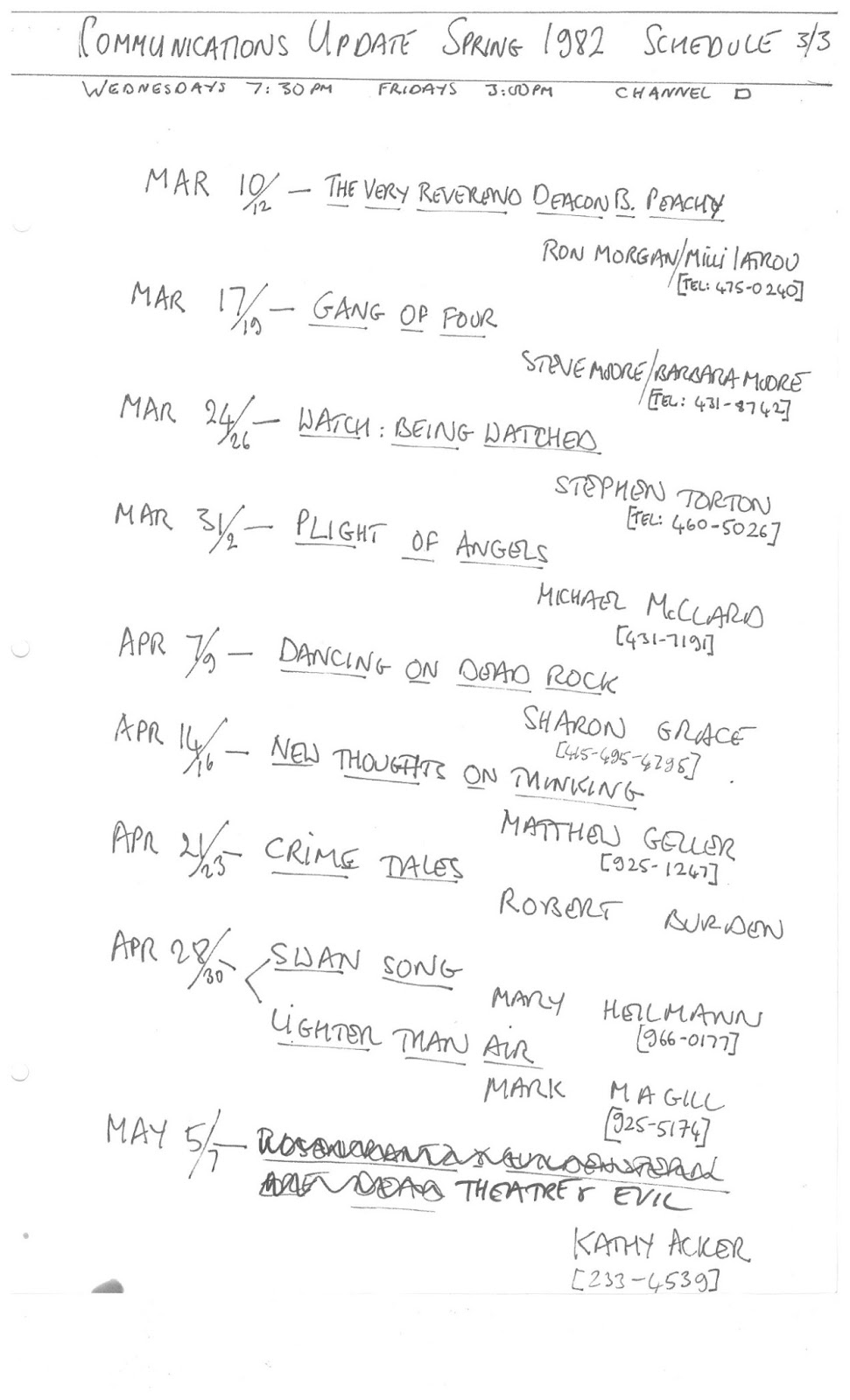
Liza Béar and Milly Iatrou present segments from Communication Update's Spring 1982 series at New Museum including "The Very Reverend Deacon b. Peachy," "A Matter of Facts," "Crime Tales" and "Lighter Than Air."
Mark Magill
Lighter Than Air, 1982
Mark Magill
Lighter Than Air, 1982
by Mark Magill
Ronald Morgan
The Very Reverend Deacon b. Peachy, 1982
by Iatrou and Morgan
A satire of tele-evangelism. The Very Reverend and Sister Mary Lola in this first episode of an on-going saga.
A 60-minute version of this program is now running on Monitor B in the Fifth Floor resource room of the New Museum. It will continue to play for a week through next Thursday. Museum admission is FREE on Thursdays from 7 to 9 pm.
Crime Tales, 1982
by Robert Burden and Dictelio Cepeda
On location in Union Square, New York: hard facts and hard humor about a hard way of life, Music by E.J. Rodriguez.
by Robert Burden and Dictelio Cepeda
On location in Union Square, New York: hard facts and hard humor about a hard way of life, Music by E.J. Rodriguez.
A Matter of Facts, 1982
by Eric Mitchell
in collaboration with Squat Theatre
Starting with a scene from Squat Theatre's Mr Dead and Mrs Free, A Matter of Facts draws a parallel narrative which follows the characters into real life.
by Eric Mitchell
in collaboration with Squat Theatre
Starting with a scene from Squat Theatre's Mr Dead and Mrs Free, A Matter of Facts draws a parallel narrative which follows the characters into real life.
Ronald Morgan
The Very Reverend Deacon b. Peachy, 1982
by Iatrou and Morgan
A satire of tele-evangelism. The Very Reverend and Sister Mary Lola in this first episode of an on-going saga.
A 60-minute version of this program is now running on Monitor B in the Fifth Floor resource room of the New Museum. It will continue to play for a week through next Thursday. Museum admission is FREE on Thursdays from 7 to 9 pm.
Monday, March 12, 2012
30th Anniversary: The Very Reverend Deacon b. Peachy
March 10, 2012, marked the 30th anniversary of The Very Reverend Deacon b. Peachy's first broadcast on Communications Update. We will commemorate the occasion by sharing excerpts on the Iatrou and Morgan channel.
Friday, February 3, 2012
C-Update 1980 Series 1: Excerpts
BLOGGER TECH ISSUES RE-UPLOADING.
For video excerpts go to LINKS
Sunday, July 17, 2011
Saturday, July 2, 2011
Crime Tales by Robert Burden/Dictelio Cepeda, 1982, excerpt
from the Communications Update, Spring 1982, series
Lighter Than Air by Mark Magill, 1982, excerpt
from the Communications Update, Spring 1982, series
For Mark Magill's Theory of Ideas,
also shown on C-Update, see LINKS.
For Mark Magill's Theory of Ideas,
also shown on C-Update, see LINKS.
Saturday, June 4, 2011
The Very Reverend Deacon b. Peachy: Episode One, March 1982, excerpt
from the Communications Update, Spring 1982, series
Sunday, April 10, 2011
1985: The New York Times on CITV
“The series was launched in 1979 by the video producer Liza Bear under the title of ''Communications Update,'' its territory the exploration of issues in telecommunications and related technology. In 1983, the program was somewhat fancifully rechristened to reflect its changing orientation as a forum for experimental video makers.
According to Milli Iatrou, who took over as the series' executive producer in 1984, ''Cast Iron TV'' has now presented about 100 different programs. ...
Most of them share a playful street- smartness and a deep affinity for the textures of life in New York City. Their looseness of form and less-than- lavish production values are frequently used for purposeful effect, to provide an ironic commentary on commercial television's glossiness and tired formulas. ...
The series features not only productions that ''Cast Iron'' commissions but previously existing video works as well, most of which are brought to Miss Iatrou's attention by word of mouth. A ''core group of five or six'' video artists contributes regularly to the series' original productions, Miss Iatrou said, ''with everyone working in several capacities.'' ...
Over the years, several of the productions that originated on ''Cast Iron TV'' have been shown in video festivals held in Bonn, Bologna and The Hague, as well as at the Museum of Modern Art. The latest tribute to the series came earlier this year when the American Museum of the Moving Image, the film archives located in the Kaufman Studios in Astoria, Queens, screened four ''Cast Iron TV'' segments.
''We try to show things that are experimental in form or content, but which are accessible as well,'' Miss Iatrou explained. Accessibility, however, is somewhat inhibited by the extremely limited budget on which the series operates - ''the toughest thing we have to deal with,'' she said. A half-hour of ''Cast Iron TV'' typically costs $500 to produce, with some of the segments coming in for as little as $200. Grants from the New York State Council on the Arts have helped defray production costs.”
Source: "CABLE TV NOTES: Experimentation Shapes Cast Iron TV", Steve Schneider, New York Times, April 14, 1985
for full article see PRESS on horizontal menu bar
Saturday, April 9, 2011
The Cable Review Lounge

In 1983 THE KITCHEN created THE CABLE REVIEW LOUNGE which, "was conceived as a bi-monthly get-together for people interested in artist-produced cable programming.
Cable Review will serve three purposes: to enable people who previously have been unable to view the programs to see them, to provide an opportunity for various cable producers to discuss developments in cable, and to introduce people to public access television."
Participating shows included:
Paper Tiger
Cast Iron TV
Artists Television Network
Potato Wolf / Fresh Potatoes
Source: KITCHEN press release, "Cable Review Lounge", MaryAnne McGowan,1983
Tuesday, April 5, 2011
Cast Iron TV: Programs

"Cast Iron TV (which airs Wednesdays at 7:30 on Manhattan Cable and Group W’s channel D) has a broad range of styles and concerns, from documentary to abstract narrative. The series has featured an interview with a Polisario representative from the Sahara, explored the implications of world satellite regulation, raised questions about police responsibility for the death of artist Michael Stewart, and parodied religious fund-raising shows.
The Reverend Peachy has appeared in five segments ... Among other things, the Reverend has tackled the topic of artists’ housing, pointing out little-known architectural features such as aerobic stairs and multipurpose sinks (good for washing paint brushes, dishes and faces). Appropriately, producers Millie Iatrou and Ron Morgan shoot the Peachy segments on Beta equipment in their own apartment. ... The series, now coordinated by Iatrou, has run over the years on a shoestring budget of $200 per show, and the individual producers generally recruit their own volunteer crews.
Like several of the New York artist-run series, Cast Iron occasionally airs alternative programming from abroad. Last summer it picked up a BBC “access” show which indicted racism on English TV. ... Another program, by documentarians David Pentecost and Lyn Tiefenbacher, explored the relationship of deforestation and the cultural survival of Mayan Indians."
Source: “Artists Gain Access to Cable”, Kathleen Hulser, Videography, Vol. 10, No. 1, January 1985
For more schedules see PAGES.
Subscribe to:
Posts (Atom)